Connection should not depend on chance encounters
Jamie values close friendships but relies too heavily on running into people to make plans. They need gentle reminders and a lightweight way to see availability without individually texting everyone.
Helping Northeastern students turn shared availability into spontaneous time with friends
NUdge prototype:Making it easier to connect with friends
NUdge is a concept for Northeastern students who want to spend more time with friends they care about but do not see regularly. Academic demands, co-op cycles, study abroad, and changing housing arrangements make it easy for friendships to become infrequent—even when people live close by.
Our team designed NUdge to reduce the coordination required to make casual plans. Instead of texting several people to find out who is free, users can share availability at a level they control and receive a nudge when a friend is available to hang out.
For Northeastern students, demanding coursework, co-op, NUin, Global Scholars, and study abroad interrupt the routines and chance encounters that sustain friendships. The barrier was rarely a lack of interest; it was the friction of finding a mutually available moment and initiating a plan.
We interviewed six Northeastern students to understand their relationships with frequent and infrequent friends, their comfort with sharing availability, and the role that housing, co-op, introversion, and busy schedules play in social connection.
Students wanted connection to feel low-pressure and spontaneous. Current calendar tools felt too formal, while texting multiple people to coordinate was slow and uncertain.
Jamie values close friendships but relies too heavily on running into people to make plans. They need gentle reminders and a lightweight way to see availability without individually texting everyone.
Dani wants organic, low-effort connection but finds formal scheduling tools too clinical. They need to control what friends can see without exposing their full calendar.
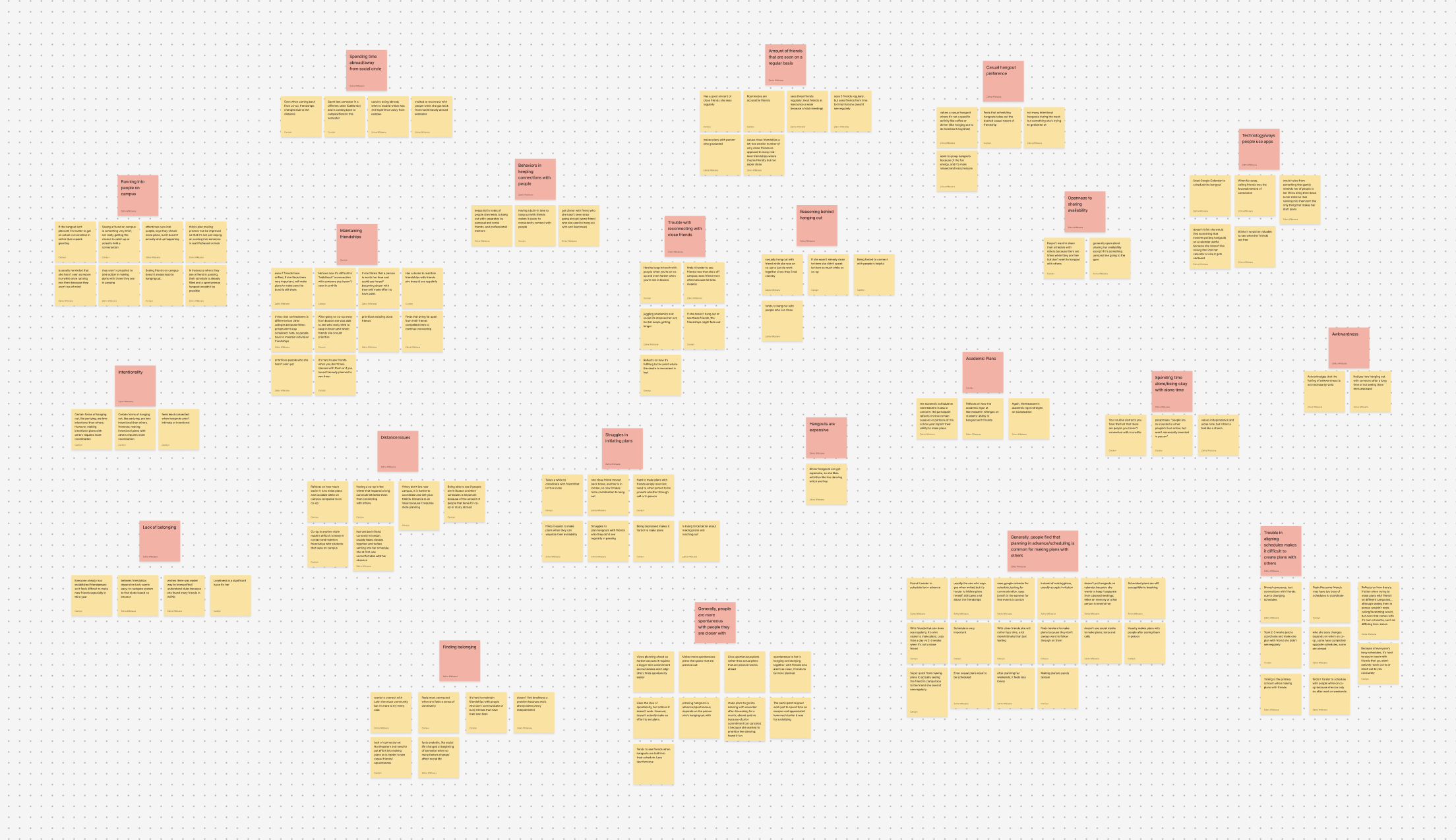
After affinity mapping our interviews, we found that students wanted to maintain friendships despite busy and misaligned schedules.
Plans rarely start unless people happen to run into one another.
Calendar coordination feels like scheduling a meeting rather than making a casual plan.
Co-op cycles, travel, and changing schedules make proximity unreliable.
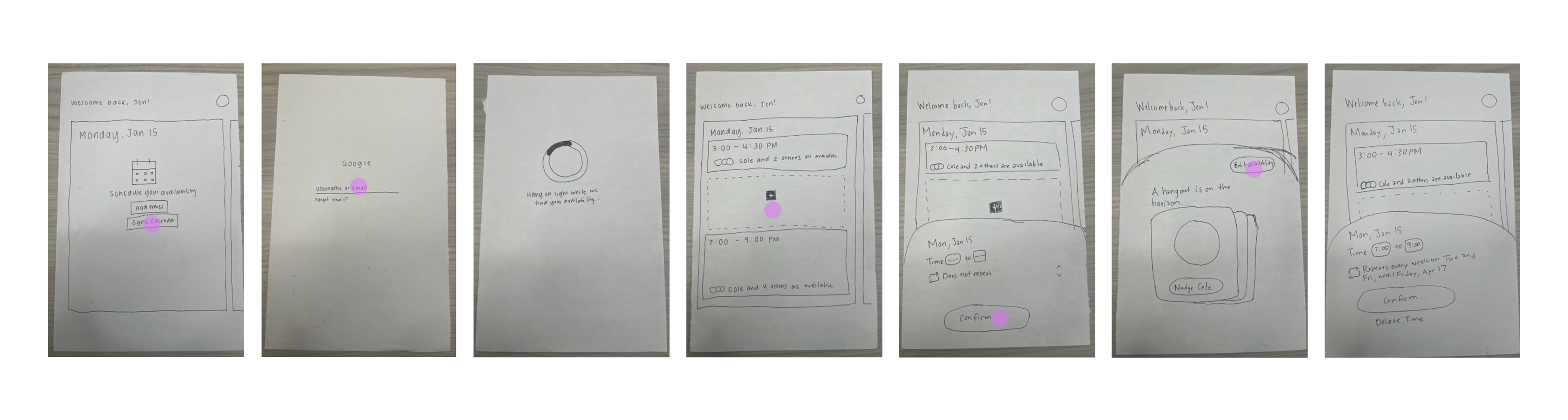
A new user syncs Google Calendar, reviews the imported week, edits their availability, and confirms who can see it.
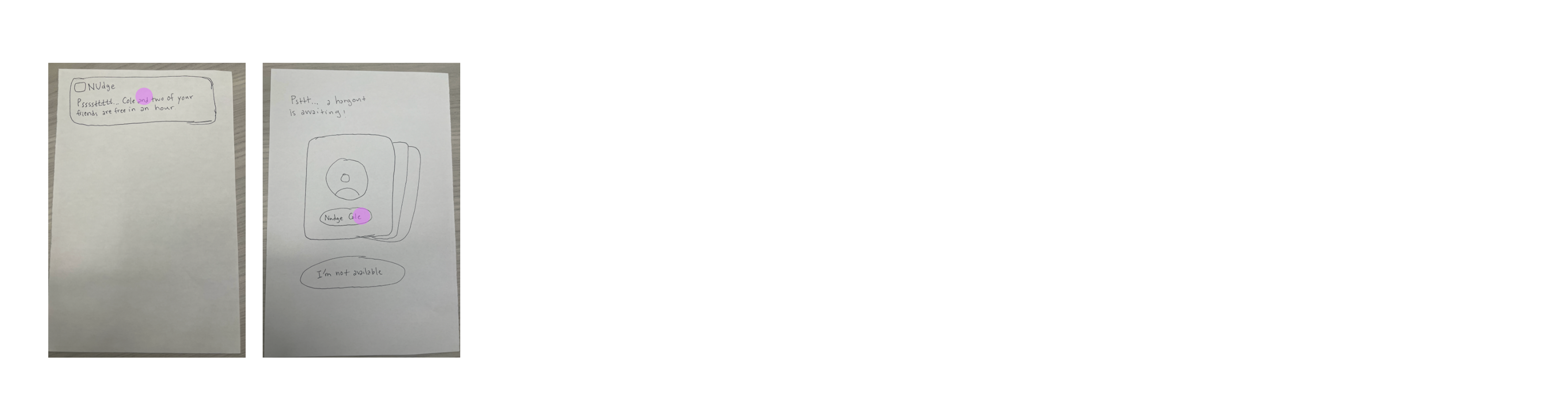
A user receives a notification that friends are free in an hour, reviews the available people, chooses who to contact, and starts making a plan.
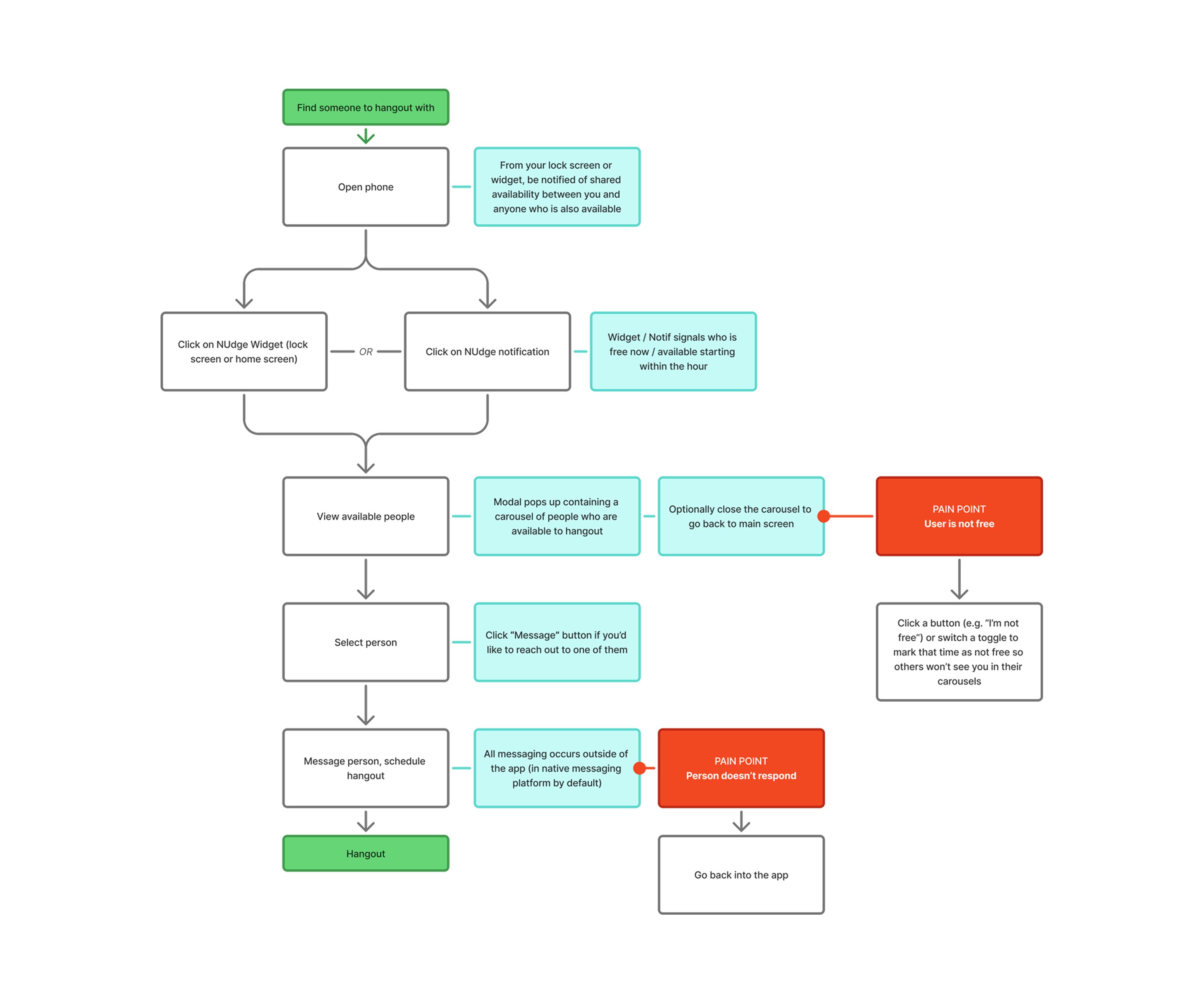
We created a hierarchical task analysis for finding someone to hang out with. It identified points where the experience needed to reduce uncertainty: knowing who is free, understanding whether the time is now or later, controlling visibility, and deciding how to reach out.
Receive a shared-availability notification or widget signal.
See who is free and decide whether to participate.
Select one or more friends, or hide availability.
Use native messaging to begin making a plan.
Participants liked importing a calendar, seeing friends’ availability in one place, and the idea of notifications. But testing showed that several core actions were unclear or required too much recall.
“Nudge” did not communicate that an action would open messaging, so we used clearer action language.
People wanted to see who was free without clicking into individual time blocks or a carousel.
Combining availability editing and social actions in one time-block interaction caused confusion.
A plus button between time blocks felt ambiguous, so we moved it to a more central, fixed action.
Participants wanted to select multiple friends rather than contact one person at a time.
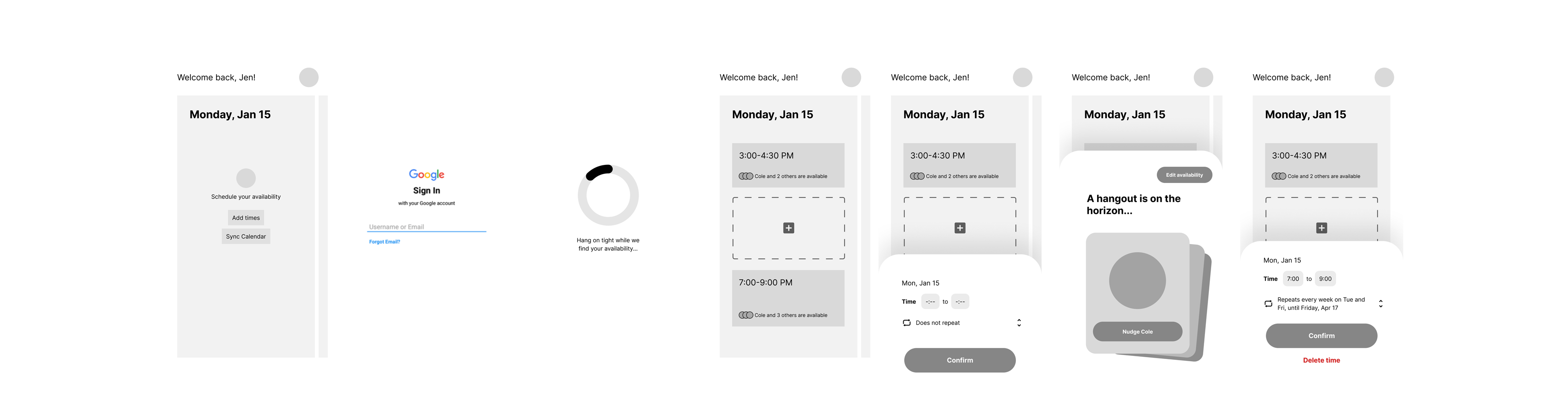
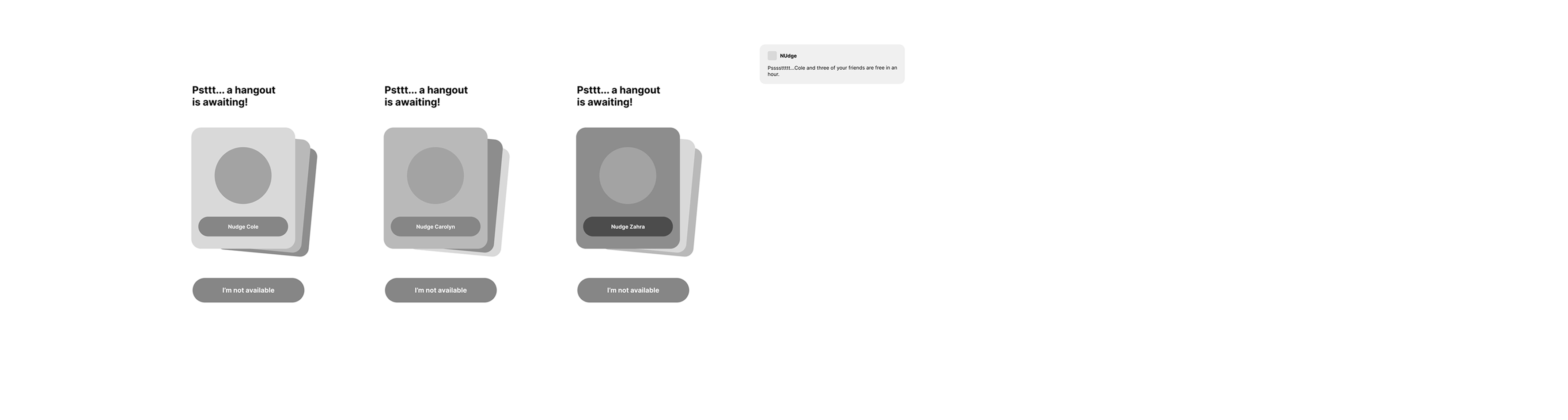
We changed the edit flow so users could use a meatballs menu to edit or delete an availability block rather than tapping the block and encountering mixed actions. We also added multi-person selection, more flexible availability hiding, and the ability to edit availability details from the notification flow.
Our revised task asked users to edit a calendar-imported availability block and make it visible to all friends, then schedule a hangout with both Amy and Lola after a shared-availability notification.
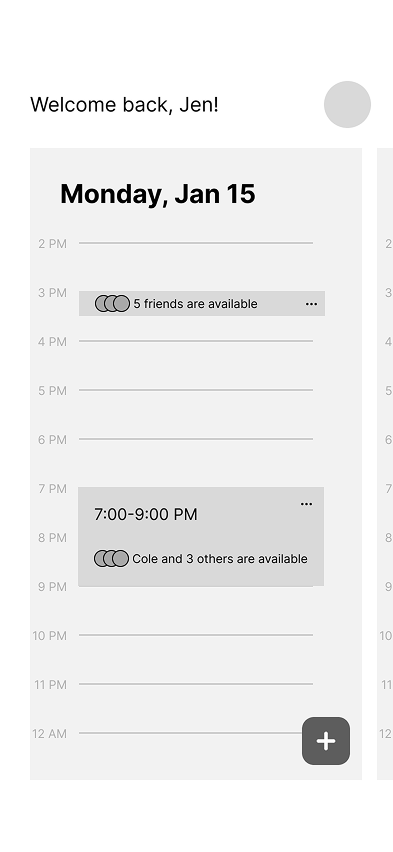
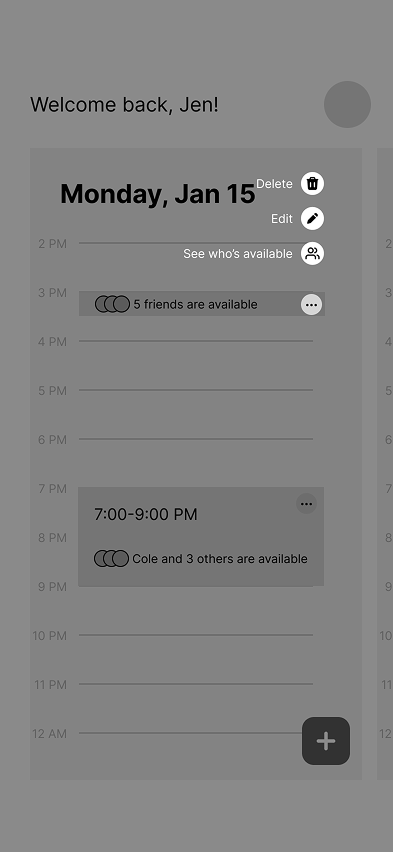
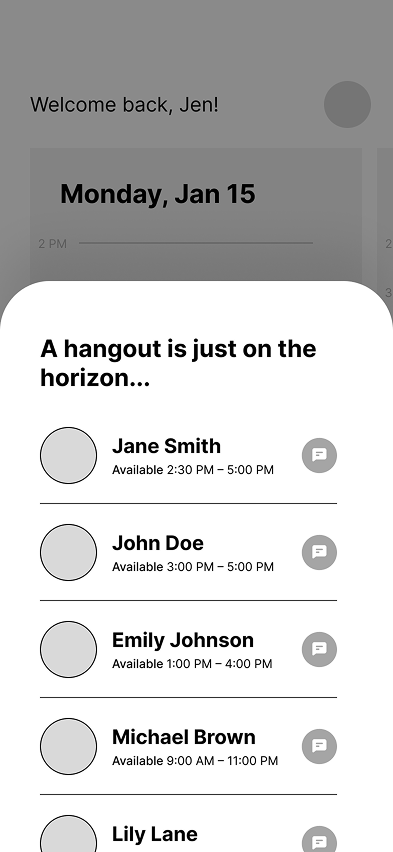
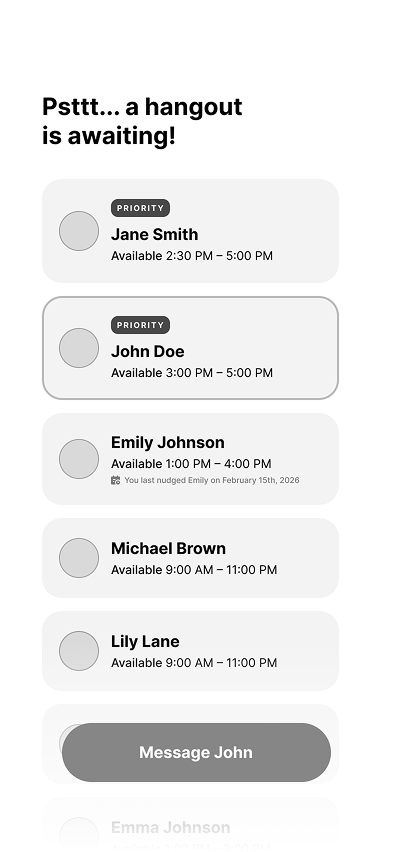
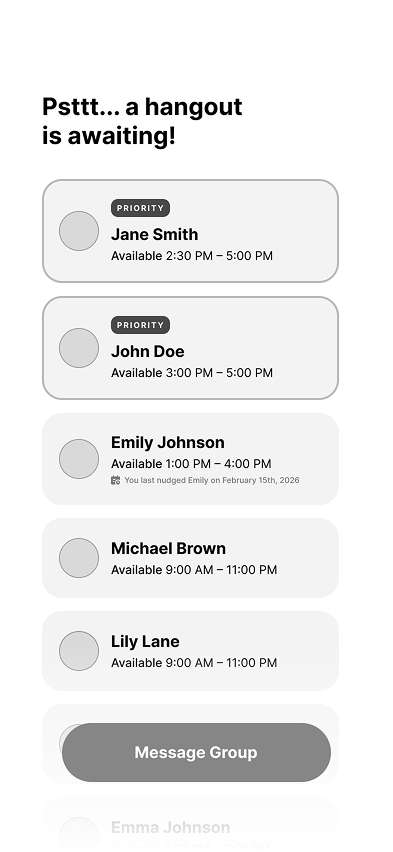
Round-one testers found the UI clear, polished, and easy to navigate. The next round confirmed that hierarchy, grouping, and realism supported task completion—but also revealed three remaining clarity gaps.
Made the timing and purpose of the notification and drawer more explicit.
Added clearer defaults and visual states for friends who were not selected.
Improved the title and supporting copy so people understood their next action.
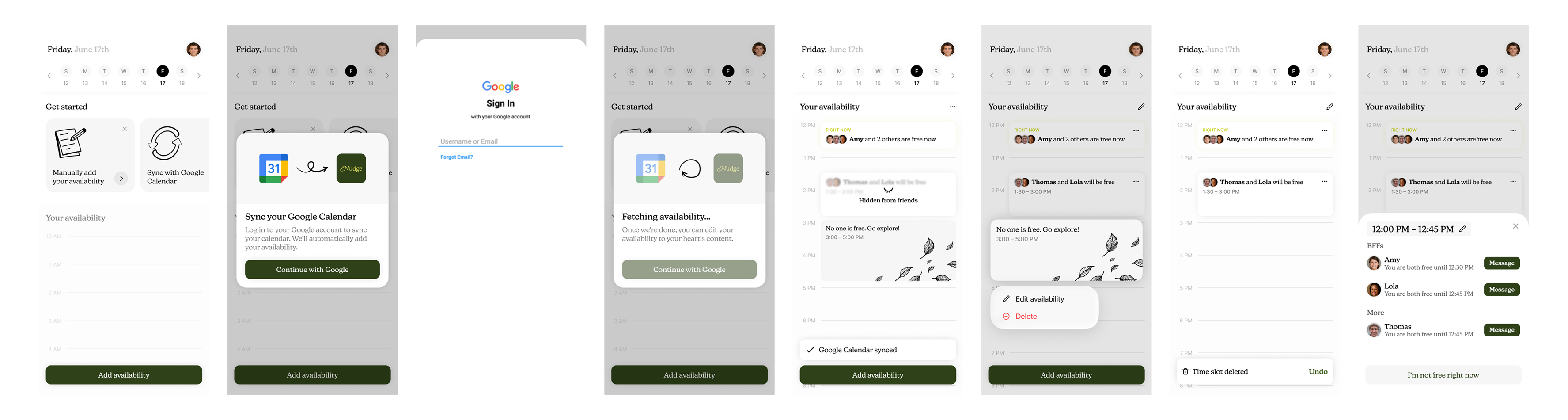
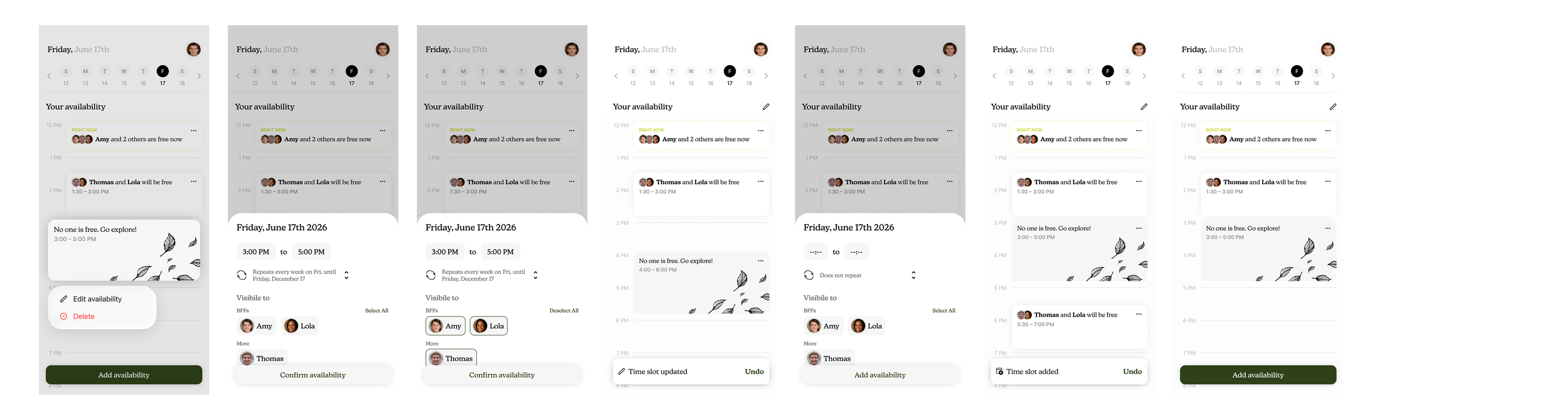
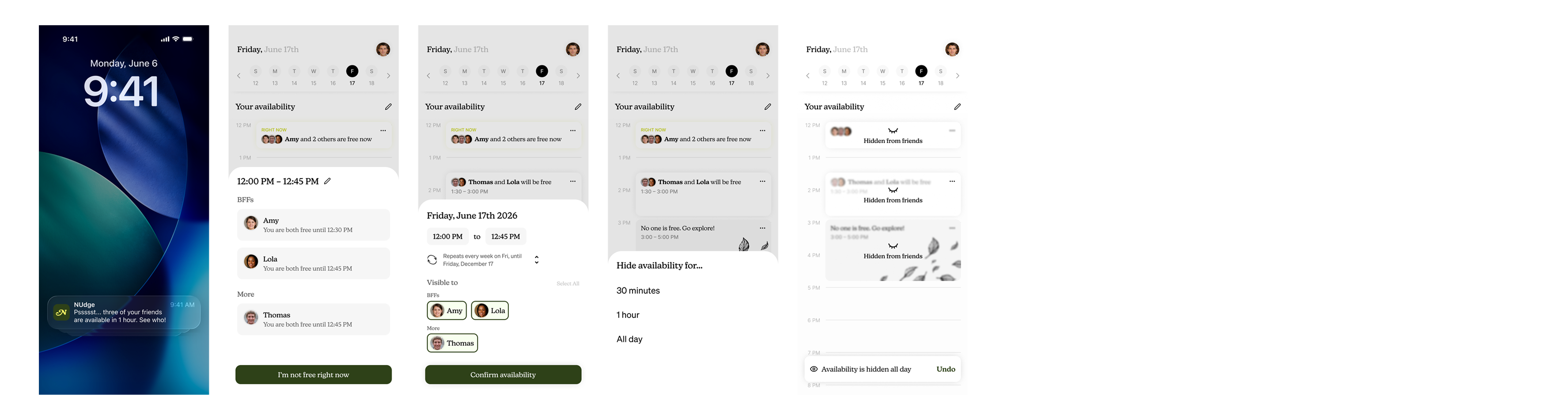
NUdge brings shared availability, privacy controls, and a familiar messaging handoff into one low-pressure experience. Rather than asking students to schedule a formal event, it helps them notice a free moment and take the small step that starts a hangout.
The project reinforced that designing against loneliness is not only about creating another social platform. It is about reducing the small moments of friction that keep people from acting on relationships they already value.